When winter bites in Victoria, nothing compares to the rapid, enveloping warmth of gas ducted heating. It has been the absolute backbone of climate comfort across Melbourne households for decades. However, when the seasonal shift brings those intense, oppressive summer heatwaves, a heating-only system leaves your home vulnerable to uncomfortable indoor conditions.
Historically, upgrading to central air conditioning meant installing a separate network of ducts or removing your existing heating framework entirely, both of which involve substantial capital expenditures.
Fortunately, there is a far more efficient engineering solution: add-on cooling in Melbourne. By integrating a high-performance refrigerated cooling unit with your pre-existing gas infrastructure, you can establish comprehensive, year-round climate management through a single, unified footprint.
At Specialized Heating and Cooling, we specialise in maximising the utility of your existing home infrastructure. This guide outlines exactly how add-on technology functions, evaluates its structural prerequisites, and illustrates why it represents the smartest cooling upgrade for Victorian properties.
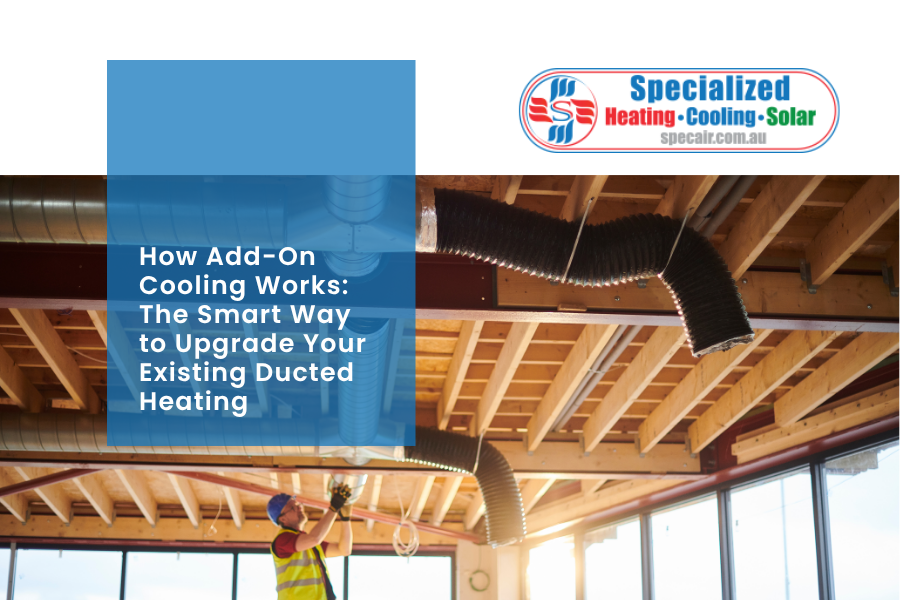
The primary advantage of this technology lies in its ability to leverage your existing assets. Instead of executing a redundant structural overhaul, technicians execute a cooling upgrade on your existing duct system.
The installation relies on pairing two distinct operational components with your current heating setup:
When you switch your system to cooling mode via your central thermostat, the external compressor initializes, chilling the internal evaporator coil. Instead of igniting the gas burners, your existing heater internal fan activates independently. It draws warm ambient air from your living spaces, drives it across the newly chilled coil to strip away temperature and humidity, and redistributes crisp, refrigerated air back through your original floor or ceiling registers.
Opting to add cooling to gas ducted heating offers several structural and operational advantages over installing separate split systems or independent ducted networks.
1. Significant Capital Savings on Infrastructure
Because this approach utilizes a retrofit cooling system in Melbourne, it circumvents the need to procure, route, and install a brand-new layout of flexible ducts. This drastically limits both equipment manufacturing costs and manual labor requirements during installation.
2. A Single, Unified Internal Footprint
Instead of cluttering your ceiling space with multiple ducts running or filling your wall surfaces with bulky multi-split indoor heads, add-on systems use your existing registers. Your interior aesthetic remains completely uncompromised, operating from a single, centralized thermostat.
3. True Refrigerated Performance
Unlike evaporative options, an add-on refrigerated cooling Victoria upgrade delivers precise climate management. It operates efficiently irrespective of high ambient humidity or extreme outdoor temperatures, reliably dropping internal living zones to your exact chosen setpoint.
While an add-on installation is an exceptionally efficient pathway to summer comfort, not every gas ducted heating system is automatically compatible. Before proceeding, our technical team evaluates several critical engineering parameters.
Airflow and Fan Capacity
Refrigerated cooling requires higher airflow volumes and velocity than standard heating to distribute air conditioning evenly. The fan motor inside your existing gas furnace must possess sufficient capacity (often rated as an “add-on compatible” multi-speed or variable-speed fan) to handle the increased static pressure of a cooling cycle.
Ductwork Integrity and Rating
This is a critical element of a ducted heating cooling upgrade. Heating ducts are frequently smaller or carry lower insulation ratings than standard refrigerated cooling lines. If your current ducts are uninsulated or structurally compromised, cold air can cause external condensation (“sweating”), leading to plaster damage. We verify that your ductwork meets modern, moisture-resistant standards before pairing it with a compressor.
Spatial Clearance Around Your Furnace
Because the internal evaporator coil must be placed directly in line with the main furnace output, there must be adequate physical clearance inside your roof cavity, under your floor, or within your external utility cupboard to accommodate the physical addition of the coil housing.
To understand how a structural retrofit compares alternative residential cooling methods commonly deployed across Victoria, review the engineering overview below.
| Feature Matrix | Add-On Refrigerated Cooling | Multi-Head Split Systems | Independent Evaporative Setup |
| Utilization of Existing Assets | Maximum (Uses current fan/ducts) | None (Entirely separate hardware) | None (Requires independent duct run) |
| Interior Visual Impact | Zero (Uses existing floor/ceiling vents) | High (Wall-mounted units in each zone) | Moderate (Requires extra ceiling vents) |
| Humidity Management | Excellent (Active dehumidification) | Excellent (Active dehumidification) | Low (Introduces additional moisture) |
| Installation Structural Load | Low (Internal component addition) | Moderate (Wall drilling and external piping) | High (Requires roof cutting and flashing) |
Because add-on cooling relies on your existing heating fan, managing air distribution carefully ensures optimal energy consumption. This is achieved via advanced zoning dampers.
When heating a home, warm air naturally rises and distributes rapidly. Conversely, chilled air is dense and requires precise management to drop effectively into living zones. By integrating electronic dampers into your upgraded system, you can direct the highest volume of cooling exclusively to high-use zones, such as the kitchen and living areas during peak afternoon heat, or bedrooms during hot summer nights.
Isolating unoccupied rooms prevents your external compressor from drawing unnecessary power, significantly reducing monthly electrical expenditures while maintaining peak climate control where it matters most.
Can add-on cooling be attached to any brand of gas ducted heater?
Add-on systems are highly adaptable but require a compatible furnace fan. While they integrate seamlessly with premium brands like Brivis, Braemar, and Vulcan, the heating unit must have an airflow capacity designed to manage the static pressure of a cooling coil. Our technicians verify compatibility during your initial site assessment.
Will upgrading to add-on cooling require me to change my existing vents?
In most instances, your existing floor or ceiling registers remain intact. However, because cold air behaves differently than warm air, our engineering team inspects the placement and material composition of your current vents to ensure they can distribute chilled air efficiently without causing condensation buildup.
How long does a standard add-on cooling installation take to complete?
Because the foundational duct infrastructure is already established within the home, a standard residential retrofit is highly efficient. A professional installation team can typically complete the structural mounting of the outdoor condenser, integration of the indoor coil, and electrical commissioning within a single working day.
Is it more energy efficient to install add-on cooling or separate split systems?
For comprehensive, whole-home coverage, an add-on system is highly efficient as it utilizes a centralized, high-efficiency inverter compressor. While individual split systems are economical for cooling in a single isolated room, deploying multiple split heads across an entire house typically results in higher cumulative power consumption.
Does an add-on cooling system require a separate thermostat controller?
No, modern add-on retrofits are engineered to integrate directly with advanced digital thermostats. Your single, centralized controller will feature an option to transition seamlessly between heating, cooling, and fan-only modes, allowing you to manage your home’s entire annual climate from one point.
What maintenance is required to keep a retrofitted cooling system operating optimally?
Regular maintenance is vital to protect your dual-system configuration. We recommend a comprehensive professional service every two years. This protocol includes cleaning the shared return air filters, checking refrigerant pressure lines, inspecting the condensate drainage tray, and ensuring your heating fan remains balanced.
Transforming your current heating system into a comprehensive, year-round climate control asset requires precise technical calibration and specialized installation experience. At Specialized Heating and Cooling, we evaluate your existing furnace model, duct insulation values, and electrical infrastructure to deliver a perfectly engineered add-on solution that maximizes home comfort while minimizing initial capital costs.
We source and integrate high-capacity, energy-efficient add-on components from industry-leading manufacturers, ensuring your upgraded asset performs reliably during Victoria’s peak summer demands.
Contact Specialized Heating and Cooling today for a free quote or expert advice.
Get a Free Quote Online or call us on (03) 9743 7633.

Pakenham is a growing area with plenty of new housing estates and older family homes. Keeping your house comfortable through changing Victorian seasons requires a reliable heating and cooling setup. Standard heaters often struggle during hot summer days, while old cooling units fail to keep living rooms warm or cold on winter mornings. Getting a […]

Melbourne winters in the outer south-east bring icy winds, cold mornings, and sudden drops in temperature. Keeping a family home warm and dry needs a central heating system that is strong, reliable, and cheap to run. For local homeowners, booking a professional ducted heating installation in Berwick is the best way to get whole-house warmth […]
It’s easy for Melbourne summer to get very hot. There can be a cool morning but a dry afternoon which equals 40 degrees or more and makes your home feel like an oven. In Victoria, with the severe heat that comes with it, it becomes necessary for every family to keep their home cool, fresh, […]

Victorian summers turn homes into ovens and running heavy aircon all day leaves you with massive power bills. Evaporative air conditioning in Melbourne is usually a lot cheaper and kind of a natural way to take the edge off heat. It brings in fresh outside air, cools it across wet pads, then sort of pushes […]
